

Brown Kraft Sell Sheets: An Earthy, Eco-Conscious Alternative
Introduction
By hour two of any trade show, the glossy white handouts on every table start to blur together. In our experience printing thousands of sell sheets for businesses across the US, the piece a buyer actually carries back to the office is usually the one that felt different in the hand before they read a single word of it.
Brown kraft is one of the fastest ways to get that reaction without redesigning your whole brand. It is warm, tactile, unmistakably natural, and it reads as environmentally considered before your copy makes a single claim. This guide covers what kraft stock actually is, which brands it suits, how to design for it so your colors do not disappear, and where it fits alongside the rest of your print kit.
What Are Brown Kraft Sell Sheets?
A sell sheet is a single-page, information-dense handout built to support a sales conversation: one product or service, the key facts, and a clear next step. Brown kraft sell sheets do that same job on unbleached kraft paperboard instead of a white coated sheet.
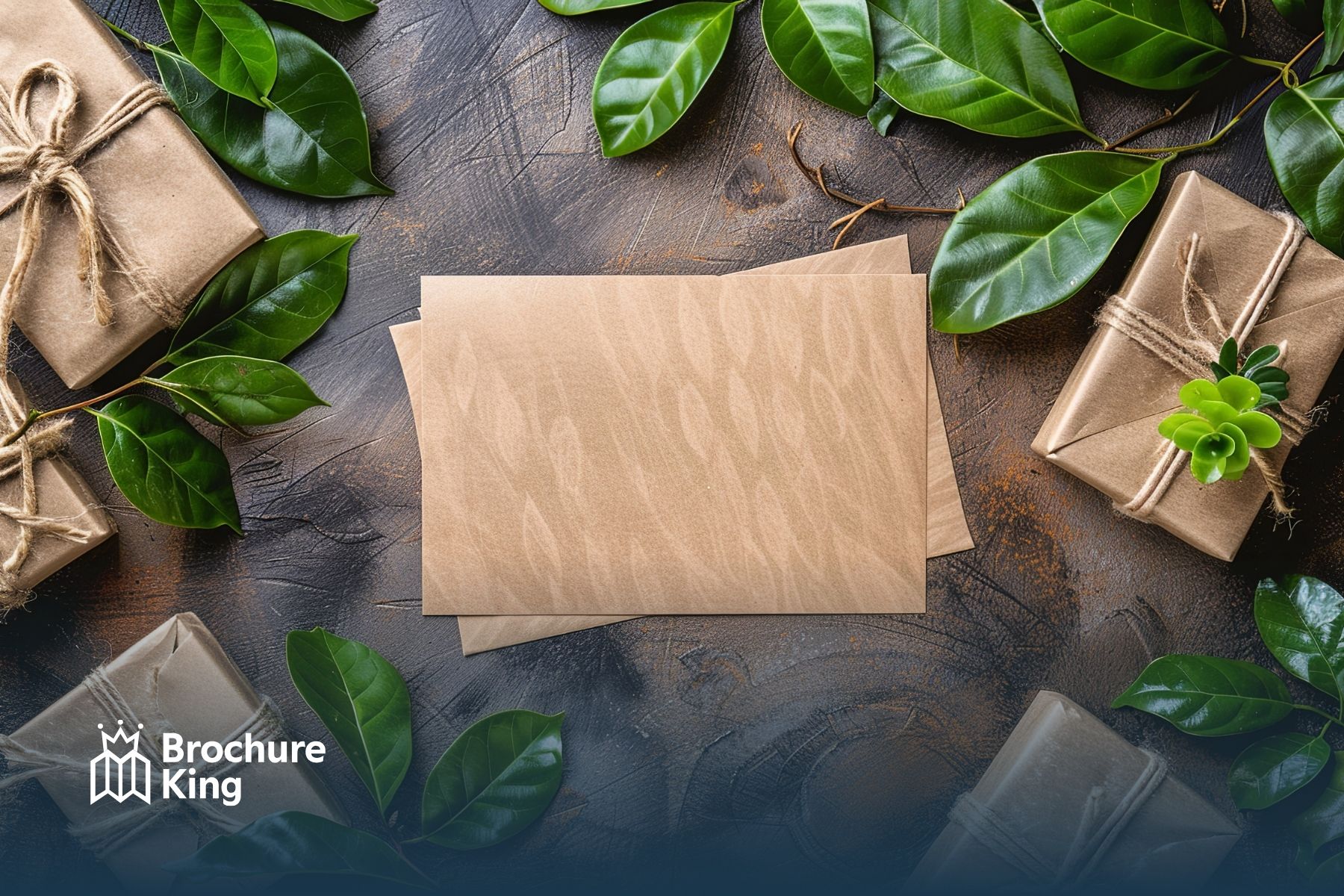
Kraft paper takes its name from the kraft pulping process, where "kraft" is the German word for strength. The process produces long, durable fibers and skips the bleaching stage that turns most paper white, which is where the characteristic tan-brown color comes from. What you get is a sheet with visible fiber, a slightly toothy surface, and real rigidity.
Our Brown Kraft sell sheets print on 18PT uncoated kraft with no coating applied, so nothing sits between the ink and the paper fiber.
How Kraft Stock Differs From Coated Sell Sheet Paper
Coated stock has a thin clay layer sealing the surface. Ink sits on top of that layer, which is why gloss and silk sheets produce sharp, saturated, photo-accurate color.
Uncoated kraft has no such layer. The ink soaks into exposed fiber. That single difference drives everything else: the texture you feel, the muted color you see, and the design decisions covered further down. It also means kraft never produces glare under trade show lighting, which is a genuine practical advantage when someone is reading your sheet across a table.
Why Brown Kraft Sell Sheets Signal Eco-Consciousness
Kraft carries an environmental association that customers pick up instantly, and that association is not arbitrary. Unbleached paper skips a chemical processing stage. Uncoated paper carries no plastic or clay layer, which keeps it straightforward to recycle through standard paper streams.
That last point matters more than most brands realize. According to the EPA, roughly 46 million tons of paper and paperboard were recycled in 2018, a recycling rate of 68.2 percent, the highest of any material in municipal solid waste. Paper is one of the few marketing substrates with genuinely mature recovery infrastructure behind it.
Making Sustainability Claims You Can Actually Back Up
Here is where we see businesses get themselves into trouble. Printing on kraft stock does not entitle you to print "100% eco-friendly" across the header.
Federal Trade Commission guidance on environmental marketing claims consistently warns against broad, unqualified green language, because customers read far more into phrases like "eco-friendly" than the marketer intended. The safer and more persuasive approach is specificity. "Printed on unbleached, uncoated kraft paperboard" is a factual statement about your sheet. "Recyclable with paper" is verifiable. Vague superlatives are neither.
In practice, the specific version performs better anyway. Buyers who care about sustainability are the same buyers who notice when a claim is doing nothing but taking up space.
Which Businesses Get the Most From Brown Kraft Sell Sheets
Kraft is not a universal upgrade. It is a strong fit when the material is saying something true about the product.
It works particularly well for food and beverage producers, especially specialty coffee, baked goods, and craft products where kraft already appears on the packaging. It suits skincare, wellness, and natural products lines. Home goods, furniture, and construction trades use it to signal substance and durability. Nonprofits and sustainability-focused organizations use it to keep messaging and material consistent. Wedding, event, and hospitality vendors reach for it when a glossy sheet would feel too corporate.
The common thread is that kraft supports a story the brand is already telling. Where there is no such story, it can be read as a costume.
When Kraft Is the Wrong Choice
Skip Kraft when your sell sheet leans on photography. Product shots, before-and-after images, and anything requiring accurate skin tones will lose noticeable punch on uncoated stock.
Skip it when brand color accuracy is non-negotiable, such as a precisely specified corporate blue that clients will hold against your website.
Skip it when the sheet needs to project clinical precision. Medical devices, financial services, and technical specification sheets generally land better on a clean coated or silk finish. If your project falls into one of these categories, our full range of sell sheet finishes includes common coated, silk, suede, and pearl options built for exactly that.
Designing for Brown Kraft: What Actually Prints Well
This is the section that saves reprints. Kraft is unforgiving of files designed as though they were headed for white paper.
Understanding Color on Uncoated Stock
Every color you print on kraft mixes optically with a brown background. Light colors lose the most. Pale yellows, soft pastels, and light grays can disappear almost entirely.
There is also a measurable density effect. PRINTING United Alliance notes that on uncoated stock, ink absorbs into the sheet and spreads, producing lower solid ink densities, typically 0.30 to 0.40 density points below coated paper, along with increased dot gain and a reduced color gamut. Translated into practical terms: midtones fill in and darken, and the range of reproducible color narrows.
Design accordingly. Favor bold, high-contrast color over subtle gradients. Deep greens, burnt orange, navy, black, and cream all hold up well. Avoid fine hairline rules and type below about 8pt, since ink spread thickens both.
Working With White Ink Masking
White ink masking is what makes kraft genuinely versatile rather than limiting, and it is the option most first-time kraft buyers do not know exists.
A white mask lays down an opaque white base under selected artwork before the color prints on top. Colors placed over that mask reproduce close to how they would on white stock. Everywhere you leave unmasked, the kraft shows through.
That gives you deliberate control. Mask your logo and product photography so they stay accurate, then let headlines and background areas sit directly on bare kraft for texture. We offer masking on the front, the back, or both sides, alongside standard four-color options. We have seen this used well on a coffee roaster's sell sheet where the bean origin map was masked for clarity while the entire narrative section printed straight onto the paper.
If you leave a design entirely unmasked, embrace it. Line art, single-color logos, and typographic layouts look intentional on raw kraft in a way a washed-out photograph never will.
Sizes, Stock, and File Specs
Brown Kraft sell sheets print on 18PT uncoated kraft, in five sizes: 8.5" x 11", 8" x 10", 9" x 12", 11" x 17", and 6" x 18". The standard letter size fits folders, binders, and mailers without modification. The 6" x 18" is worth considering for retail shelf talkers and menu-style layouts.
Quantities run from 100 to 1,000, and standard turnaround is four business days with rush options available.
For file setup, build to our template with 0.125" bleed on all sides, CMYK color, and 300 DPI minimum. Outline or embed your fonts. Print-ready PDF is preferred, though we also accept AI, PSD, INDD, JPG, and PNG. Our team reviews every file before it goes to press and will flag anything that looks likely to cause trouble on kraft specifically.
Fitting Kraft Sell Sheets Into a Wider Print Kit
A sell sheet rarely travels alone. The most effective kraft rollouts we print keep the material consistent across the touchpoints a prospect encounters in a single meeting.
The usual pairing is a sell sheet inside a folder, handed over with a business card. If you are going kraft on the sheet, think carefully about the carrier: our standard presentation folders hold letter-size sheets cleanly, and a restrained, uncoated folder keeps the whole package coherent rather than fighting itself.
One practical note from experience: pick one or two pieces to carry the kraft texture rather than every piece. A kraft sell sheet inside a clean folder reads as a deliberate choice. An entire kit in kraft can read as a budget decision, which is the opposite of the impression you want.
Conclusion
Brown kraft sell sheets trade photographic color accuracy for texture, warmth, and an immediate environmental signal. They suit brands whose products already tell a natural, artisanal, or sustainability-minded story, and they underperform for photo-driven or precision-color work. The design rules are straightforward once you know them: favor bold contrast, avoid delicate light tones, use white ink masking where accuracy matters, and keep type comfortably above the minimum. Pair the sheet with a restrained folder, keep your environmental claims specific and verifiable, and you have a piece that survives the trade show table.
Ready to Print?
Brochure King prints and ships nationwide, with local service for businesses in Lakewood, NJ, Brooklyn, NY, and the Five Towns, NY.
If you’re weighing kraft against a coated finish or want a second opinion on whether your artwork will hold up on uncoated stock, contact us today at 732-660-KING (5464). Our team can walk you through the options, help you choose the right finish, and request a quote today before you commit to a run.
Frequently Asked Questions
What are brown kraft sell sheets used for?
Brown kraft sell sheets are single-page handouts printed on unbleached, uncoated kraft paperboard. Businesses use them for product overviews, menus, brand storytelling, trade show handouts, and direct mail where a natural, textured look supports the product better than a glossy white sheet.
Can you print full color on brown kraft paper?
Yes. Full-color CMYK printing works on kraft, but the brown paper mutes lighter colors and reduces the overall color range. White ink masking solves this by laying an opaque white base under selected artwork so those areas print close to how they would on white stock, while the rest of the design lets the kraft texture show through.
Are brown kraft sell sheets recyclable?
Uncoated kraft paperboard has no plastic or clay coating, so it is recyclable through standard paper recycling streams. The EPA reports paper and paperboard as the most recycled material in US municipal solid waste. When advertising this, state the specific fact rather than a broad "eco-friendly" claim, which is harder to substantiate.
